By Philomina Brando
The Federal Government has assured Nigerians that the cause of the Abuja–Kaduna passenger train derailment on August 26, 2025, will be made public within 23 days. The Nigerian Safety Investigation Bureau (NSIB) is leading an independent probe into the incident, which injured 12 passengers but caused no fatalities.
The ill-fated service, designated Abuja–Kaduna AK1, derailed at Asham Train Station around 11:07 a.m. According to the Nigerian Railway Corporation (NRC), the train had departed Idu Station in Abuja at 09:45 a.m. with 583 passengers and crew on board. It made a scheduled stop at Kubwa Station at 10:04 a.m. before continuing north.
However, trouble struck shortly after passing a switching point at Asham Station. “Five coaches derailed, with the forward locomotive and two coaches overturning. The rear locomotive and the last coach remained stable on the track,” NRC officials confirmed in a statement.
Eyewitnesses initially reported about 50 injured passengers, but official figures later clarified that 12 people sustained minor to moderate injuries. They were quickly given first aid and transferred to hospitals for further treatment.
Transport Minister Said Ahmed Alkali commended the swift response of emergency agencies. “The NRC, security operatives, and first responders acted promptly to secure the site and ensure the safety of passengers. We must acknowledge their professionalism and bravery in the face of danger,” Alkali told journalists in Abuja.
The incident caused significant damage to tracks, sleepers, and switching mechanisms. The NRC has since suspended train services along the Abuja–Kaduna corridor pending repairs and safety clearance.
The NSIB, which operates under the Railways (Investigation of Accidents and Incidents) Regulation 2024, has deployed its team to conduct a comprehensive investigation. The Bureau is tasked with gathering and analysing evidence to identify the direct and contributing causes of the derailment.
Captain Alex Badeh, Director-General of NSIB, said the investigation would be impartial and thorough. “Our team is conducting a meticulous examination of the site, the rolling stock, and all operational records. We are interviewing passengers, crew, and eyewitnesses to reconstruct events leading up to the derailment,” Badeh explained.
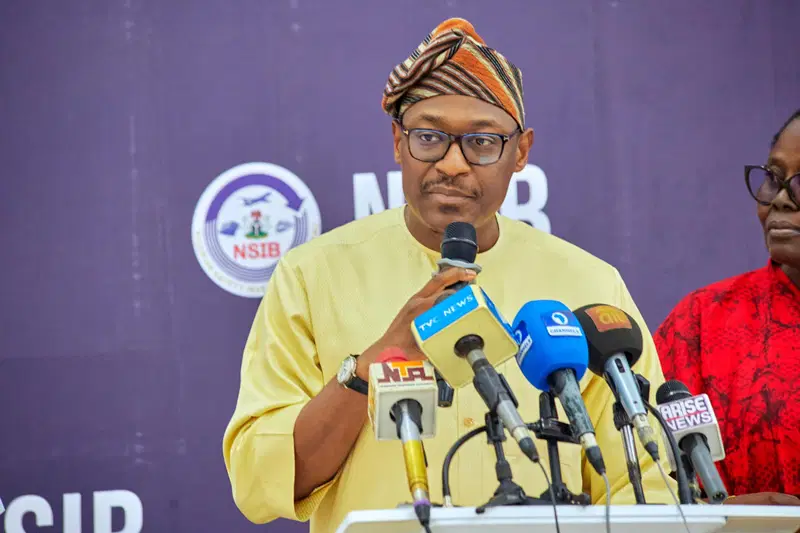
He stressed that the Bureau’s work is not about assigning blame but about preventing future accidents. “We aim to produce a Draft Final Report within 23 days, which will be shared with stakeholders for consultation. Thereafter, a Final Report with actionable safety recommendations will be released to the public,” he added.
The derailment has once again raised questions about the safety of Nigeria’s rail infrastructure, which has experienced growing patronage since the Abuja–Kaduna service was launched. Analysts note that while the service has boosted economic activity and provided an alternative to the highway plagued by insecurity, concerns remain about track maintenance and operational safety.
Minister Alkali assured the public that lessons would be learned. “We take this incident seriously. The Federal Government will act on the NSIB’s recommendations to ensure rail travel remains safe and reliable. The lives of Nigerians must never be put at unnecessary risk,” he said.
Passengers who spoke to reporters expressed relief that the derailment did not claim lives but urged the government to invest more in rail safety. “We thank God there were no deaths, but it was a terrifying experience. Government must ensure this does not happen again,” said Ibrahim Musa, one of the survivors treated for minor injuries.
As repairs continue on the damaged stretch, the NSIB’s findings are expected to provide clarity not only on what caused the derailment but also on measures needed to prevent similar occurrences.
“The safety of passengers remains our top priority. Whatever the findings, they will guide corrective action,” Captain Badeh emphasized.
With public attention now focused on the forthcoming report, Nigerians await answers and assurances that their journey on the nation’s busiest rail corridor will be safer in the future.