By Mercy Gadia
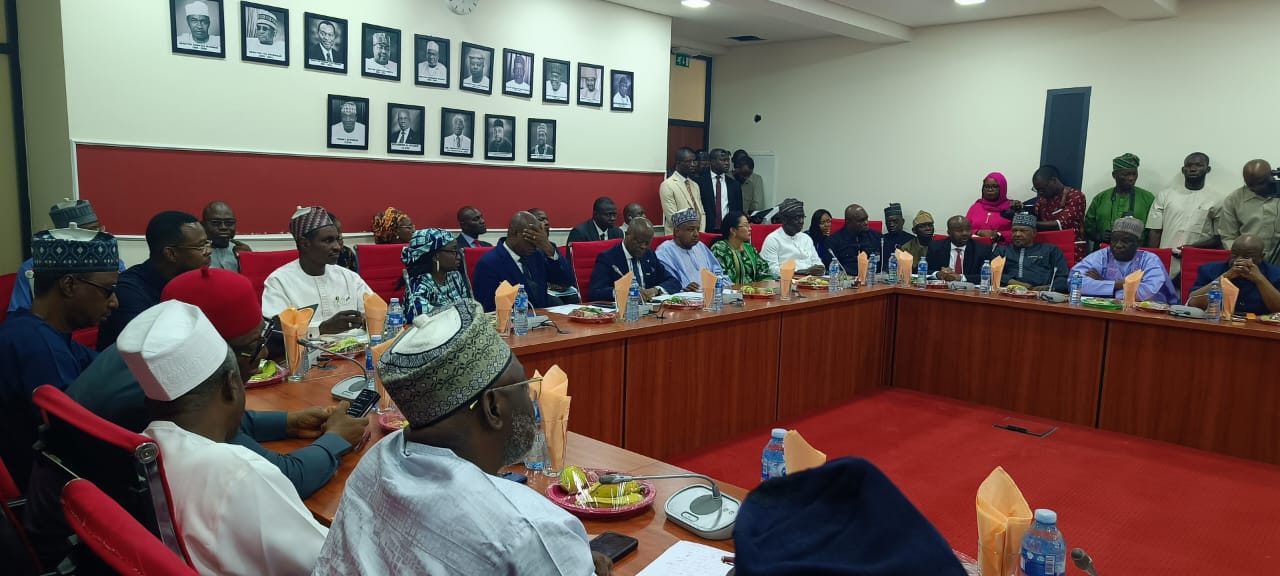
Tension heightened at the Senate on Wednesday as lawmakers subjected the Federal Government’s economic managers to a rigorous interrogation over the proposed ₦58.19tn 2026 budget, demanding explanations for revenue failures, rising debt and funding gaps that undermined the 2025 fiscal plan.
Chairman of the Senate Committee on Appropriation, Senator Solomon Adeola (Yayi), set a firm tone at the session, declaring that the era of rubber-stamp budgeting was over.
Adeola said the committee had summoned the President’s full economic team to defend both the performance of the 2025 budget and the assumptions underpinning the 2026 proposal.
According to him, the exercise goes beyond routine oversight.
“We want to see how far the administration has gone, what is left undone, and how the committee can address the challenges confronting government finances,” he said.
The lawmaker also announced a major fiscal shift, stating that by March 1 Nigeria would operate a single active budget year, ending the practice of overlapping budgets.
He explained that outstanding commitments from the 2024 and 2025 fiscal years would be rolled into the 2026 appropriation.
Adeola further reminded Ministries, Departments and Agencies of the presidential directive requiring them to fund 30 per cent of prior obligations before March 2026, while the remaining 70 per cent would be absorbed into the new budget framework.
The hearing, however, nearly stalled at the outset as lawmakers openly accused key economic officials of disrespecting the Senate following repeated postponements and late appearances.
Some agencies failed to appear entirely, drawing sharp criticism from members of the committee.
One senator warned that the National Assembly could suspend the budgets of defaulting agencies.
“This sitting has been postponed more than five times. We cannot continue like this,” the lawmaker said.
Despite the tension, the committee allowed the Minister of Finance and Coordinating Minister of the Economy, Mr Wale Edun, to make his presentation.
Edun told the committee that the Federal Government had adopted a three-stage recovery strategy comprising market corrections, stabilisation and growth acceleration targeted at achieving 7 per cent GDP expansion.
He said the administration was prioritising private investment through public-private partnerships, asset optimisation and improved domestic revenue mobilisation.
According to him, the medium-term target is to raise tax revenue to 18 per cent of GDP.
The minister, however, warned that Nigeria was operating in a difficult global environment where many developing countries now repay more in external debt than they receive in investment and aid.
He cited a $20bn investment commitment from Shell as a signal of improving investor confidence in Nigeria’s reforms.
Edun admitted that the 2025 budget recorded significant shortfalls.
He disclosed that Federation revenue performance stood at 53 per cent, while oil and gas revenue performance was only 18.9 per cent.
Capital budget implementation reached 51.8 per cent.
The minister further revealed that federal revenue fell short by about ₦5tn, while debt service exceeded projections by ₦4tn, creating an overall funding gap of roughly ₦9tn.
“As a result, government prioritised salaries, pensions and statutory transfers, while capital projects suffered. Actual receipts barely covered recurrent expenditure,” Edun said.
He explained that the Federal Government was hit harder than the states because its major revenue share from oil declined sharply, while non-oil revenues largely accrued to sub-national governments through VAT allocations.
Addressing concerns over Nigeria’s public debt, now estimated at about ₦152tn, Edun maintained that the spike largely reflected accounting adjustments rather than excessive new borrowing.
He said ₦30tn previously recorded as Ways and Means advances had been formally recognised, while about ₦49tn arose from exchange-rate revaluation.
According to him, only about ₦27tn represents fresh borrowing by the current administration.
“This increase is driven mainly by accounting corrections, not excessive borrowing,” the minister said.
Despite fiscal constraints, Edun said the government had continued to fund key intervention programmes, including cash transfers to nearly nine million households, wage awards and increases, and the CNG transport initiative.
He attributed the growing backlog of unpaid contractor liabilities to violations of procurement and fiscal responsibility rules by some agencies that entered commitments without proper approvals.
Lawmakers repeatedly pressed the minister on whether the oil revenue assumptions behind the 2026 budget were realistic.
Edun said final validation rests with the relevant revenue-generating agencies, noting that the credibility of oil revenue projections would largely determine the success of the new budget.
The central concern of the Senate remained whether Nigeria could realistically fund a ₦58.19tn budget after achieving barely half of its revenue target in 2025.
Lawmakers warned that the outcome would determine whether the proposed budget becomes a genuine recovery instrument or deepens the nation’s fiscal deficit.
The hearing is expected to continue as other members of the economic team appear before the committee in what observers describe as one of the most consequential fiscal reviews of the current administration.