…Corps says last patrol vehicles were procured in 2013, pushes tech-driven enforcement
By Ebiere Kekeboro
The Senate Committee on Federal Character and Inter-Governmental Affairs has pledged to strengthen legislative oversight of the Federal Road Safety Corps as the agency appealed for increased funding, modern equipment, more personnel and legislative backing to enhance road safety operations across the country.
The commitment followed an interactive session between the committee and the leadership of the FRSC, led by the Corps Marshal, Shehu Mohammed, in Abuja.
Chairman of the committee, Senator Ede Dafinone, said the engagement was part of ongoing efforts to reposition the committee’s oversight functions after recent leadership changes in the Senate.
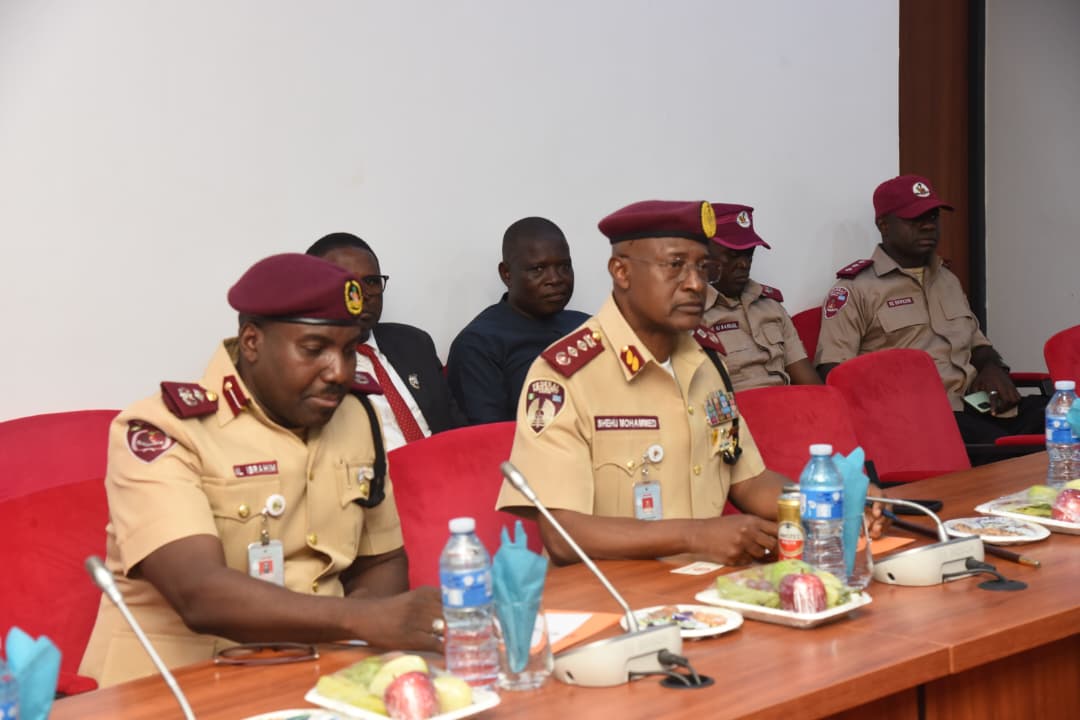
He explained that the meeting was in line with Order 96, Subsection 27, Item 80 of the Senate Standing Orders 2026, which empowers the committee to supervise agencies under its jurisdiction.
Dafinone said the panel would develop strategic frameworks to improve institutional efficiency, service delivery and accountability.
“We are building relationships with stakeholders in this critical segment of the public service to elicit ideas, share concerns and advance a strategic plan of action for the committee,” he said.
He added that the committee would intensify oversight visits, public consultations and investigative hearings to address institutional gaps.
Presenting the Corps’ position, Mohammed described road traffic crashes as a major public safety concern, noting that Nigeria’s vast road network makes traffic management a national priority.
“Our primary mandate is to reduce road traffic crashes and fatalities and create an enabling environment for motorists to travel safely across Nigeria,” he said.
He identified inadequate funding as a major challenge, revealing that the Corps still operates with ageing patrol vehicles, with the last major procurement done in 2013.
“The last time operational vehicles were purchased for the Federal Road Safety Corps was in 2013,” he said.
Mohammed disclosed that the Corps is transitioning to technology-based enforcement through the deployment of body cameras, digital monitoring systems and modern control centres.
“We are shifting towards technology-based enforcement using body cameras and modern control rooms that enable us to monitor our operatives in real time,” he said.
The Corps Marshal also raised concerns over manpower shortages, noting that hundreds of officers would be required to effectively manage traffic in the Federal Capital Territory alone.
“Our personnel strength is not adequate for the volume of work before us,” he added.
He further appealed to the National Assembly to consider a bill allowing selected FRSC personnel to bear arms, stressing that the move was necessary for the protection of officers and operational assets.
“The purpose is not to confront motorists but to protect our personnel, facilities and support enforcement operations,” Mohammed said.
On compliance challenges, the FRSC boss attributed widespread overloading and traffic violations to poverty, lack of public transportation and low literacy levels.
“When we stop overloaded vehicles, the passengers ask us, ‘What option do we have?’” he said.
He also disclosed that some high-profile individuals frequently violate traffic regulations, particularly traffic lights, citing security concerns.
Mohammed, however, announced improvements in driver’s licence processing, assuring that applicants would now receive their licences within two weeks after biometric capture.
“Within the next one month, we will launch and implement the contactless driver’s licence system,” he added.
In their contributions, committee members suggested extending the validity of driver’s licences to five or ten years to ease administrative pressure on motorists.
The session ended with both parties reaffirming their commitment to collaboration to reduce road crashes and improve safety on Nigerian roads.